
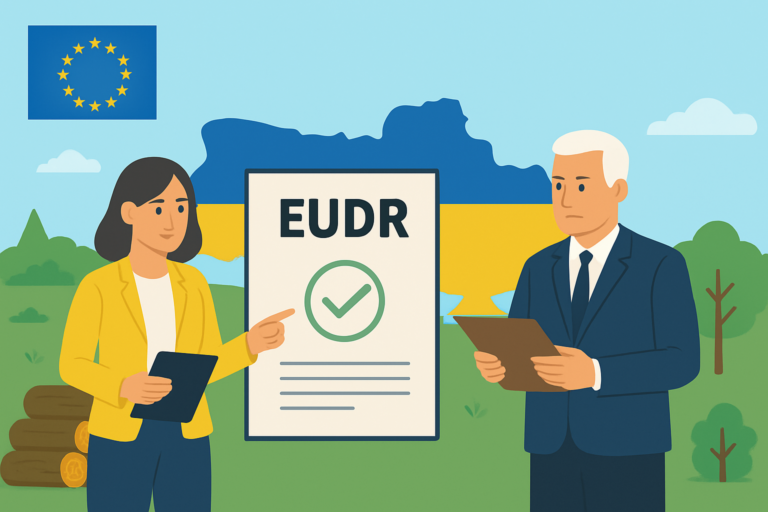
Global environmental challenges — deforestation, ecosystem degradation, and climate change — require new mechanisms for regulating international trade. The European Union, as one of the key consumers of agricultural and forest-based commodities that may be linked to deforestation, adopted in 2023 Regulation (EU) No. 2023/1115, better known as the EU Deforestation Regulation (EUDR).
The purpose of the EUDR is to prevent products whose production has caused deforestation or degradation of natural ecosystems after December 31, 2020, from entering the EU market. The regulation applies to products such as wood, coffee, cocoa, soy, palm oil, beef, rubber, and certain derived goods. It represents one of the EU’s most ambitious steps toward ensuring sustainable supply chains.
Key Requirements of the EUDR
The EUDR establishes strict rules for all operators and traders who first place products on the EU market or export them from it. All such companies must carry out due diligence — a comprehensive procedure including the collection of documents and data on product origin, risk assessment, and measures to minimize risks.
Operators must ensure full traceability of the supply chain down to the specific plot of land where the raw material was grown or produced. This requires providing geolocation coordinates of the production site, confirmation of legal land use, and compliance with local environmental legislation.
A product is considered “deforestation-free” if it does not originate from land converted from forest after December 31, 2020, and if its production complies with the legislation of the country of origin.
The regulation is directly applicable in all EU member states. Large companies must comply with its requirements by the end of 2025, and small and medium-sized enterprises (SMEs) — by mid-2026. Strict sanctions are foreseen for violations: from fines to bans on selling products on the EU market.
One of the regulation’s distinctive features is the creation of a European risk assessment system that will classify countries of origin by their level of deforestation risk. Products from “high-risk countries” will undergo more thorough checks.
Thus, the EUDR fundamentally reshapes the rules of international trade in raw materials and timber, making transparency and accountability the key conditions for access to the EU market.
Implementation of the EUDR in EU Member States
Although the regulation has direct effect and does not require formal transposition into national law, each EU member state must establish its own administrative mechanisms to monitor compliance. This includes defining competent authorities, setting up monitoring systems, inspections, and sanctions.
Most member states have designated or established special agencies responsible for oversight. For example, in Germany, the Federal Environment Agency oversees EUDR compliance and has developed detailed guidance for operators and traders. In France, an electronic platform is used for submitting product origin information, enabling effective tracking of supply chains.
European governments are actively preparing business guidelines explaining practical aspects of compliance — how to conduct geolocation analysis, what documents prove legality, how to assess risks, and how to report to supervisory authorities.
However, implementation has proven challenging. Many companies, especially SMEs, complain about the complexity and cost of traceability systems.Some supplier countries, including Brazil, Indonesia, and Côte d’Ivoire, have stated that meeting EU requirements is nearly impossible without technical and financial support.
Recognizing these difficulties, the European Commission in 2024 even considered a 12-month extension for some product categories to give businesses more preparation time. This experience is particularly valuable for countries seeking alignment with EU standards — including Ukraine.
Ukraine’s Readiness to Meet EUDR Requirements
Ukraine is an active exporter of timber, agricultural raw materials, and other goods covered by the EUDR. Therefore, compliance with the new standards directly affects access of Ukrainian products to the EU market.
Certain steps have already been taken. In 2024, several Ukrainian organizations held round tables and consultations on aligning national legislation with EUDR requirements. Participants emphasized the need to harmonize terminology, definitions, and control systems with European standards.
Experts note that technical tools for tracing timber origin already partly exist in Ukraine: electronic timber accounting systems, geolocation of harvesting sites or agricultural production, and digital databases.
However, the regulatory framework remains outdated — the current Forest Code of Ukraine requires modernization.
Ukraine also faces a number of challenges: insufficient institutional capacity of government agencies, limited resources for monitoring systems, and a high share of small producers lacking technical capacity for full due diligence.
The shadow timber market remains problematic. Nonetheless, the potential for adaptation exists. Active participation of civil society, the presence of certification experts, and the business community’s interest in maintaining EU market access create favorable conditions for adopting European practices.
Recommendations for Ukraine
To fully implement EUDR requirements, Ukraine should undertake several systemic steps:
- Update the legal framework, including adopting regulations defining the responsibilities of producers, exporters, and traders for documenting product origin.
- Establish a national competent authority responsible for monitoring and control, and develop an electronic platform for data exchange among operators, the government, and EU partners.
- Introduce a geolocation monitoring system for logging areas to ensure traceability from the source to the final product.
- Strengthen administrative and criminal liability for illegal logging, document falsification, and trade in illegal timber.
- Support small and medium-sized enterprises, which may be the most vulnerable to new requirements — through state or international assistance for certification, staff training, and adoption of digital tracking tools.
- Conduct public awareness campaigns for businesses, explaining not only the EUDR requirements but also their benefits — such as EU market access, increased consumer trust, and improved competitiveness.
- Enhance international cooperation — Ukraine can receive EU technical and financial assistance to develop monitoring infrastructure and train personnel. Joint projects with EU countries and international organizations would accelerate adaptation.
Conclusions
The EUDR is not merely a new trade regulation but a strategic instrument of the European Union to combat deforestation. Its implementation will require all market actors — from producers to traders — to demonstrate high levels of transparency, technological readiness, and environmental responsibility.
EU countries are already establishing national control systems, despite facing difficulties. For Ukraine, this represents both a challenge and an opportunity. Timely implementation of EUDR requirements will help avoid trade barriers, strengthen positions on the EU market, and show that Ukrainian products meet the highest standards of sustainable development.
Ukraine has the necessary prerequisites for successful adaptation — an active civil society, skilled professionals, and a motivated business sector. However, the decisive factors will be political will, legal reform, and the creation of a modern monitoring system.If these steps are implemented soon, Ukraine will not only meet EU standards but also become a model of ecological transformation for other Eastern European countries.